Introduction
If your task is to find candidate products from the Patagonia catalog and then continuously record whether pages are still accessible, whether specifications are complete, and which information needs rechecking, the website catalog and Google Sheets are better suited for different stages. The catalog is responsible for discovering and viewing pages, while the spreadsheet handles organizing, filtering, and tracking status. Mixing the two into one place can easily lead to mistaking the currently displayed information on a page for personal historical records, and can also cause overlooking items that need confirmation.

First Verify What the Catalog Page Can Provide
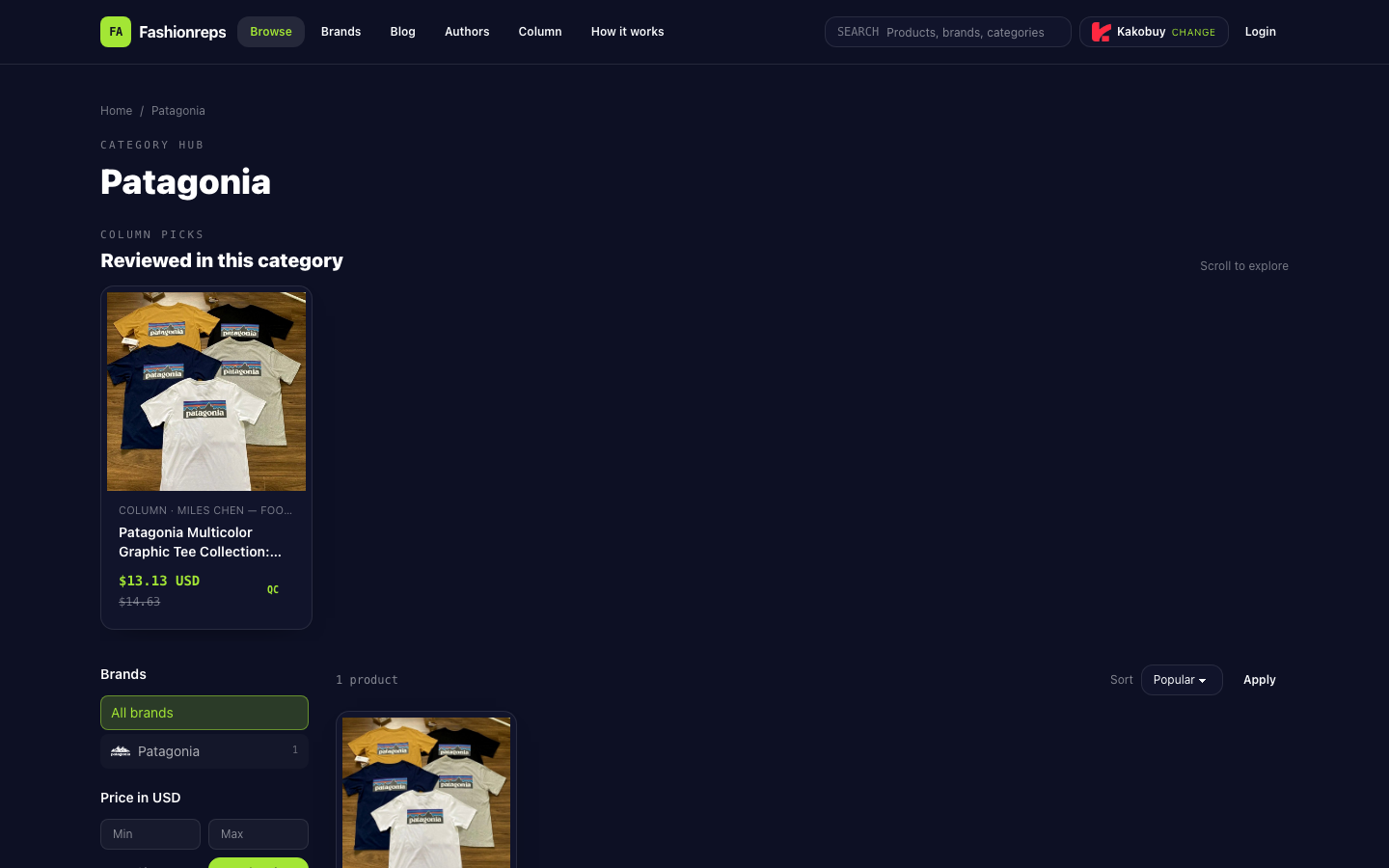
On the Fashionreps Patagonia T-shirts page viewed this time, you can see the Patagonia brand entry, category pages, product cards, price filter, and sorting options. At that time, the page displayed 1 product. The product card title was "Patagonia Multicolor Graphic Tee Collection: Heavyweight 180–250 g/m² Cotton in 15 Colorways," and it showed 15 colorways, a description of 180–250 g/m² cotton, and a reference price of $13.13, while also listing a previous reference price of $14.63.
This content is suitable for building a candidate list, but it cannot directly infer stock, shipping, final payment price, or actual purchasability. The reference price on the page should also be preserved as a page field, rather than being rewritten as a guaranteed transaction price.
The page also displays a QC entry. It can serve as an entry status for later viewing of quality inspection materials, but catalog text alone cannot prove that a specific color, size, or batch already has sufficient QC evidence. If the page does not explicitly show corresponding materials, it should be marked as pending confirmation in the spreadsheet.
The Division of Responsibilities Between the Two
| Task | Patagonia Catalog | Google Sheets |
|---|---|---|
| Discover candidates | Browse brand entry, product cards, images, and page links | Save candidate names for later filtering |
| View current page | Read the currently visible title, description, price, and QC entry | Record the viewing date and page status |
| Manage multiple candidates | Rely on page navigation, sorting, and filtering | Filter by brand, status, color, size, or to-do items |
| Track changes | Reopen the page to verify | Keep previous records, review dates, and change notes |
| Handle missing information | Only see whether the page provides fields | Clearly mark missing fields and next actions |
The catalog is the entry point for verification each time, while the spreadsheet is your own work record. Google Sheets will not automatically prove that the page information is true and valid, nor will it automatically update inventory or QC status just because a link is saved.
Recommended Record Fields
First, establish a rule of one row per product page. If the same page has multiple colors or sizes that need independent verification, you can split them into multiple rows, but keep the same page identifier to avoid mistakenly recording the same product as multiple independent sources.
It is recommended to set at least the following fields:
- Product title: Record as per the page's original text, and add a short note if necessary.
- Brand and category: For example, Patagonia, T-shirts.
- Page status: Not reviewed, accessible, information incomplete, link broken, or needs re-confirmation.
- Color and size: Fill in only when the page explicitly provides them; leave blank and mark missing if there is no evidence.
- Page reference price: Keep the USD value and the nature of "reference price," do not rewrite it as the final price.
- QC status: Not checked, entry visible, materials reviewed, or insufficient evidence.
- Page link: Save the original page address to avoid recording only the product name.
- Missing fields: Write clearly what is missing: color, size, images, QC materials, or other information.
- Last review date: Record the date when you actually opened and verified the page.
- Change notes: Fill in only when the page content has changed compared to the previous record.
Among them, "page status" and "personal record status" should be separated. For example, the page being currently accessible does not mean you have confirmed it is suitable for purchase; a visible QC entry does not mean every option has available inspection materials.
From Discovering Candidates to Marking Pending Items
Step one: On the catalog page, confirm that the brand and category are correct. First look at the page path, brand name, and product card; do not judge attribution solely based on the title in search results.
Step two: Open the candidate product page and record the title, images, specification description, reference price, and QC entry as actually displayed. Do not fill in fields that are not explicitly shown, and do not use information from other product pages.
Step three: Write the page link and review date into Google Sheets. If the page only has partial information, explain directly in the missing fields, for example, "No explicit size information seen" or "Only saw QC entry, corresponding materials not yet confirmed."
Step four: Use the spreadsheet to filter pending items. Prioritize records with broken links, unclear price nature, missing specifications, and those needing re-examination of QC materials. The filtered results are only a work queue, not a purchase conclusion.
Step five: On the next review, compare with old records. If the title, reference price, number of colorways, or visible page status has changed, update the corresponding fields and note the change; if no change is verified, do not just change the date to create a false update trace.
When to Only Use the Catalog, and When to Use the Spreadsheet
If you are only temporarily viewing one candidate, the catalog page is usually sufficient. You can directly inspect the product card, images, description, and page status, then decide whether to continue verification.
If you need to handle multiple candidates simultaneously, review links in batches, and distinguish confirmed from pending items, Google Sheets is more suitable. Its value lies in leaving behind the basis for judgment and subsequent actions, rather than replacing the catalog page.
For this particular page, a more reliable initial record should include: the original product title, the page description of 180–250 g/m², 15 colorways, the reference price of $13.13, the previous reference price of $14.63, QC entry status, page access date, and the unconfirmed color, size, stock, and purchase conditions. Stock, shipping, and final transaction price need to be verified separately in subsequent actual processes and cannot be inferred from the catalog card.
Conclusion
The most practical division of labor is: first use the Patagonia catalog to discover and view candidates, then use Google Sheets to save verification results, missing fields, and review plans. This way, you won't mistake old records in the spreadsheet for the current page status, and you'll know which information needs re-confirmation when the page changes.