
The image is an illustration of the catalog organization workflow and is not a product photo, QC, or hands-on evidence.
If you want to organize Gucci pink sweaters from the fashionreps catalog into Google Sheets, the focus shouldn't be on copying a bunch of product names first. Instead, you should set up a traceable record: where the candidate was discovered, what the page originally said, which fields have been confirmed, whether the link is still valid, and which information can't be concluded yet.
First, Confirm What the Catalog Pages Can Provide
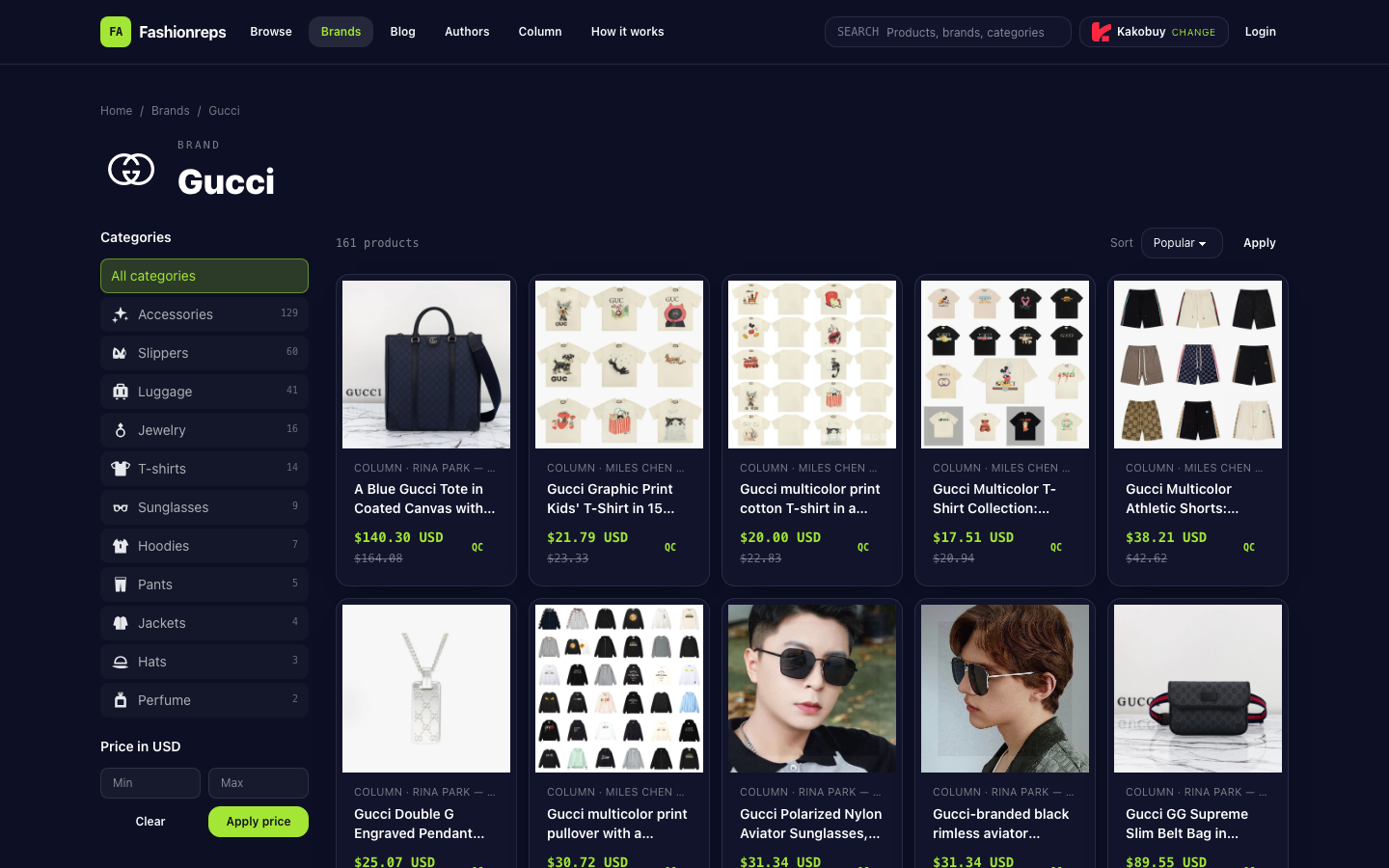
The currently verifiable Gucci brand catalog pages show that they offer brand product entries and display product counts by category. Visible categories include accessories, sliders, luggage, jewelry, t-shirts, sunglasses, hoodies, pants, jackets, hats, and fragrances. The pages also provide minimum and maximum price filters, a clear filters option, sorting by popular or latest, and sorting by price from low to high or high to low.
Product cards show editorial sections, product titles, and reference prices in USD, with some cards also displaying previous reference prices and QC sections. This content is suitable for candidate discovery and saving preliminary evidence, but it cannot directly prove that an item is still in stock, available for purchase, or that the page description covers sizing, material, and actual product condition.
The provided catalog captures do not confirm the specific product details of any particular "Gucci pink crewneck sweater," nor do they verify images, sizing, current link status, or purchase availability for that candidate. Therefore, in your organizing sheet, these fields should be divided into "Confirmed" and "Pending Review," and a candidate title should not be treated as complete product evidence.
Discovery Phase: Start by Filtering Candidates from the Catalog
You can follow this order:
- Go to the Gucci brand catalog page and look for candidates containing descriptions like sweater, pullover, knit, or similar in the product list.
- Use the existing category or price filters to narrow down the list, but don't interpret the filter results as quality, stock, or final landed price.
- Record the complete title, displayed price, previous reference price, and editorial section from the candidate card.
- Save the catalog page URL first, then enter the candidate details page for verification. If the candidate card does not clearly state pink, crewneck, or sweater type, do not mark it as the target product yet.
- Assign a unique number to each candidate to avoid confusion when items have similar names or prices change.
The goal of the discovery phase is to build a candidate list, not to immediately judge whether an item is worth buying or fits correctly.
Verification Phase: Record Page Text and Status Separately
After entering the candidate details page, check the following information one by one:
- Product title: Save the complete text currently displayed on the page.
- Color: Only fill in as confirmed if the page explicitly states pink or a corresponding color description; an image that looks pink cannot replace text verification.
- Style: Record whether the page explicitly states sweater, knit, crewneck, or other style descriptions.
- Price: Record the reference price shown on the page and note the check date; do not speculate on shipping, taxes, or final settlement amount.
- Sizing: Only copy the sizes or measurements explicitly listed on the details page; do not infer fit based on general experience.
- Images: Save the image location or page image identifier, confirming that the image actually corresponds to the current candidate.
- Link: Save the candidate details page link and reopen it to confirm the page is still accessible.
- Status: Mark as accessible, pending review, invalid, or unable to confirm; a page being accessible is not the same as stock being confirmed.
- Notes: Record missing descriptions, inconsistencies between images and text, price changes, or other points that need rechecking.
If the details page cannot be opened, the product has been removed, the link redirects abnormally, or key information is missing, stop treating it as a purchasable recommendation and only keep it as "pending review" or "invalid candidate."
Recommended Fields to Save in Google Sheets
The value of Google Sheets lies in putting multiple candidates in one table for easy filtering, sorting, supplementing evidence, and sharing with others. It should not be treated as a source of product facts; facts should still be verified against the catalog or product details pages.
Consider using the following fields:
| Field | Content to Record | Filling Principle |
|---|---|---|
| Candidate ID | Personal ID | Unique for each candidate, not reused |
| Original product title | Full title displayed on the page | Do not rewrite it into a more definitive name |
| Target color | Pink, unconfirmed, etc. | Confirm only after the page explicitly states it |
| Style description | Sweater, crewneck, knit, etc. | Only record what the page text supports |
| Current reference price | USD price displayed on page | Note the check date, do not add shipping speculation |
| Previous reference price | Previous price shown on page | Leave blank if not displayed |
| Size info | Sizes explicitly listed on details page | Fill as unconfirmed if not found |
| Image location | Image link or page image identifier | Confirm it corresponds to the current candidate |
| Details page link | Candidate page URL | Reopen periodically to verify |
| Link status | Accessible, pending review, invalid | Do not equate accessible with in stock |
| Evidence notes | Page text, missing fields, and changes | For future review |
| Last verification date | Date of most recent check | Update after page changes |
How the Website Catalog and Google Sheets Divide the Work
The website catalog is better for discovering product context. You can narrow down by category, price, or sorting on the brand page, then view titles and reference prices on product cards. It preserves the relationship between products and their original pages, making it a good source for backtracking.
Google Sheets is better for organizing across candidates. You can filter by color, link status, whether sizing has been verified, or last check date, and you can separate "confirmed" from "pending review." The benefit is reducing omissions when repeatedly opening the same candidate, but the sheet itself won't automatically confirm stock, image authenticity, or the latest page status.
Therefore, the two are not substitutes: the catalog page is for discovery and backtracking, and the sheet is for storing structured records. If you don't actually need collaboration, don't add extra complex fields just for the sake of "collaboration"; keep only the fields that help with verification.
A Complete Candidate Recording Workflow
Using a suspected Gucci pink sweater candidate as an example, you can complete a round of organization with the following workflow:
- Discover the candidate on the Gucci catalog page and copy the full title, displayed price, and catalog page URL from the product card.
- Create a candidate ID in the sheet and initially mark color, style, and size as "pending review" unless the page already clearly states them.
- Open the details page and verify the title, images, color description, size field, and page link.
- Only change "pink," "sweater," or "crewneck" to confirmed if the details page explicitly supports it.
- Write the current price, check date, and page accessibility status into the sheet; do not treat the previous reference price as the current selling price, and do not add shipping or stock information that isn't there.
- If the page is invalid or key information cannot be confirmed, change the link status to invalid or pending review and stop recommending that candidate as purchasable.
- Before next use, reopen the link and check if the title, price, images, and status have changed.
The core of this workflow is to make every record traceable back to the original page, not to make the sheet look informative. The currently verified catalog evidence is sufficient to support candidate discovery and field design, but it is not enough to confirm the specific product details, sizing, stock, or purchase outcome of a particular Gucci pink sweater.