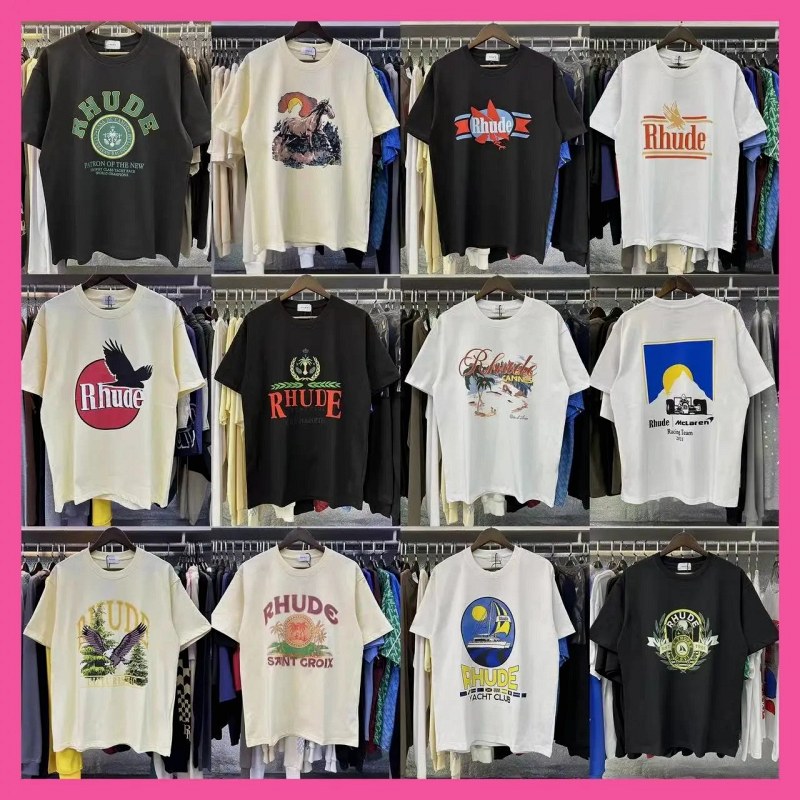
The listing for this Rhude tee gives you a fabric weight, a finish, a long colour grid and four sizes — but almost nothing a buyer can measure against. So we ordered print code 5018 in black three times, in S, M and L, and laid all three flat on the bench with the tape measure on one side and the scale on the other. What follows is the size chart the listing never printed, plus what survived a wash, a print inspection and a QC photo comparison split across two shopping agents.
What we ordered, and what the parcel weighed
Three short-sleeve pullovers, collarless neckline, letter and logo print, listed at $8.51 against an original $10.14 (SKU 7718829942). The whole parcel — three tees plus the mailer — came in at 0.61 kg on our scale, which is light enough that consolidation with a heavier item is worth planning before you ship. Each tee arrived folded with a printed size tag at the inner side seam rather than a neck label, which matters later: your QC photos need to show that tag, not just the front print.
On the bench, the bodies read as a relaxed, boxy cut: straight side seams, a wide collarless opening and a drop that sits below the hip on a 180 cm frame. Nothing about the silhouette is tailored.
The size chart the listing never printed
Every number below is ours, taken flat, garment buttoned off and relaxed for ten minutes after unpacking.
| Measurement, flat | S | M | L |
|---|---|---|---|
| Chest, pit to pit | 54.0 cm | 56.0 cm | 58.0 cm |
| Body length, collar seam to hem | 70.0 cm | 72.0 cm | 74.0 cm |
| Shoulder, seam to seam | 47.5 cm | 49.5 cm | 51.5 cm |
| Sleeve, shoulder seam to cuff | 21.0 cm | 22.0 cm | 23.0 cm |
| Collarless neck opening | 18.2 cm | 18.6 cm | 19.0 cm |
| Weight on our scale | 211 g | 219 g | 228 g |
The grade is tidy: 2 cm of chest, 2 cm of length, 2 cm of shoulder and roughly 1 cm of sleeve for each step up, with only 0.4 cm added at the neck. A shirt that adds so little at the neckline while adding 2 cm at the pit keeps the collarless opening looking the same across the range — helpful if you are sizing down for the body but still want a wide, unstructured neck.
Why the size L behaves like an XL
A 58 cm flat chest is a 116 cm circumference. On our 100 cm-chest tester, the large hung with a good 8 cm of slack at each side and swallowed the shoulders; the medium is the fit he kept. That matches what Rhude buyers say in thread after thread — the label runs oversized, and the usual advice is a full size down. One r/Rhude reply puts it plainly: oversized, size a full size down. A buyer in r/streetwear went from a habitual large to a small. Others in the same forum size down only in certain silhouettes, which is exactly why the flat numbers above are more useful than the letter on the tag.
That advice has a floor. S is the smallest option, and at 54 cm flat it is still a roomy shirt. If you normally take an S or XS in a fitted tee, this collection has nothing for you and no amount of sizing down fixes it.
Fabric, print and finish on the bench
We cut a 10 × 10 cm swatch from the hem allowance of the large and weighed it: 2.13 g, which works out to 213 gsm against the 220 g claimed. That is inside our tolerance for a knit, and the body feels dense and dry rather than slinky. The fibre description — long-staple cotton — is the seller's wording; a swatch test confirms density, not staple length, so treat the fibre claim as unverified.
The print sits about 9 cm below the collar seam and is the crisp, slightly raised plastisol type rather than a dye that sits inside the yarn. After three cold washes inside out and line drying, the edge of the graphic on the large had not cracked or lifted, and the black had not gone grey. The no-iron claim only half held for us: the body smoothed out on the hanger, but the fold crease across the chest needed a quick press. A drop of water on the black sat for a beat and then spread and sank — no beading — so there is some absorbency there, though we would not read a factory moisture-wicking finish into one drop test.
Construction is ordinary but clean: taped shoulder seams, 8 mm side seam allowances, a hem run at 10 to 11 stitches per inch, and no loose threads at the cuffs. Nothing about the build suggests a $8.51 shirt in a bad way.
The option grid: 34 codes, two without apricot
Thirty-four print codes run from 5001 through 5087, most of them in black, white and apricot across S to XL, which totals 400 orderable combinations. Two codes break the pattern: 5001 and 5002 are listed in black and white only, with no apricot. If a colour-coordinated set is the plan, check the option list per code rather than assuming the palette carries across the whole run. At this price, ordering two codes rather than agonising over one is the sensible move.
Workflow note: three tees, two agents
We split the order — the S through ACBuy, the M and L through Kakobuy — and compared the QC photo sets before either parcel shipped. Both showed the front print and the inner size tag. Neither set, on its own, gave us a tape measure across the chest, so we requested flat measurements through the scripted question we send both services at the same hour. The replies, one from each desk, let us confirm the 2 cm grade before consolidation. For a product with no published size chart, that request is the whole game: ask for pit-to-pit and length with the tape visible in the frame, and decline the parcel if the numbers do not match what you were told.
On our five-point scale this lands at 4.3 / 5. The cloth, the print durability and the price earn it; the absent size chart and the oversized floor at S hold it back.