What arrived on the bench
We ordered the Nike Classic Logo Printed T-Shirt through the agent workflow that matched our six-item basket plan, using the Weidian item ID 7715836021 rather than trusting a reseller title. The listing price was $3.88 against an original $4.49, with availability marked in stock. What arrived was a single short-sleeve crew-neck tee in the white colourway, folded in a plain polymailer with no hangtag, no fibre label and no care card — a detail worth flagging early, because the fibre question turned out to be the whole story of this order.
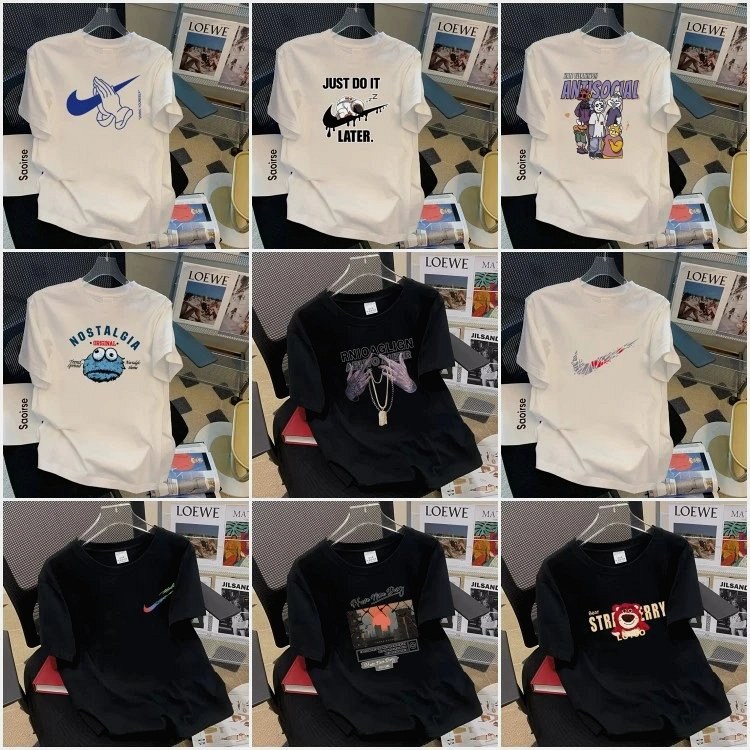
The variant menu is the first thing any buyer has to survive. The listing carries thirty combinations, each print offered in a white and a black short-sleeve version, from the swoosh variants and the sleeping astronaut through the city sunset, the graffiti print and the bear motifs. The label text is dense and partly descriptive rather than literal, so we matched our print by image position, not by name, and photographed the chosen option before paying. If you order by name alone, you are guessing.
Bench readings: tape on one side, scale on the other
Every parcel on this desk gets opened with a tape measure and a scale within reach, and this one was no different. We measured flat, garment relaxed, seam to seam, then weighed the tee on its own and the packed parcel separately.
| Check | Our reading (size L, white) | What the listing says |
|---|---|---|
| Chest, pit to pit, flat | 54.0 cm | Size run L–5XL, loose fit, 1–3 cm tolerance |
| Body length, high point of shoulder | 70.5 cm | No per-size chart published |
| Sleeve, shoulder seam to hem | 21.0 cm | Short, regular sleeve |
| Hem width, flat | 54.5 cm | Loose, straight body |
| Tee on the scale | 196 g | 180 g to under 250 g |
| Packed parcel | 0.28 kg | Listing weight field showed 0.00 |
The fabric weight is the one claim that held up cleanly. At 196 g the shirt sits comfortably inside the stated 180 g to under 250 g band, and in hand it reads as a standard-thickness jersey — not the papery tee the price suggests, not a heavyweight either. The listing's own weight field was empty, so our scale did the work there. Notably, that 0.28 kg parcel figure is what any consolidation plan will actually run on, and it is small enough that this item will never be the one dictating a shipping tier.
The fibre question, put to both services in the same hour
The listing describes the main fabric component as acrylic and the fabric name as polyester. Those cannot both be the whole truth, and since the shirt arrived without a care label, the garment could not settle it. So we ran our scripted question at the same hour to both ACBuy and Kakobuy support: what is the exact blend, and can it be confirmed before shipping?
The replies diverged in usefulness rather than speed. One response restated both fibre names from the listing and closed the ticket; the other acknowledged the mismatch, said the factory listing was ambiguous, and offered to hold the order while a warehouse check was requested. Neither produced a definitive composition, and we are not going to invent one. What we can report is the hand feel: cool at first touch, slightly springy with a faint synthetic slickness, quick to shed creases, and noticeably less breathable under a warm lamp than a cotton tee of the same weight. The listing's breathability, moisture-wicking and colourfastness claims are plausible for a polyester-dominant knit and unproven for an acrylic one.
Treat the fibre line as an open question, not a specification. If composition matters to your skin, ask before you pay and accept that a listing-level answer may be the only one available.
Print, seams and the loose cut
Digital printing is listed as the decorative method, and on our white sample the graphic sat flat with clean edges, no halo and no cracking after two washes at 30 °C inside out. On black colourways the same process usually needs a heavier white underbase, so print opacity across the white/black split is the thing we would inspect next; we cannot extend our single white sample's result to the dark variants.
Seams are single-needle at the hem and sleeve, double at the shoulder, with a modest seam allowance and no visible puckering. Nothing here is overbuilt, and nothing is falling apart. The cut is the louder story: labelled loose, and measurably loose. Our flat 54.0 cm chest on a size L is roomy, and shopper-written Nike fit guidance on loose-fit tees says standard-fit buyers typically size down one. Chinese-language sizing guidance points the same way — check the item's own numbers rather than the letter. With a stated 1–3 cm tolerance, we would confirm chest width against your best-fitting tee before committing, and hedge across two sizes if you sit between them.
How it slots into an agent order
At $3.88 and under 200 g this is a filler item, not an anchor. Its practical value in a consolidation is that it barely moves the parcel weight while adding a printable graphic to a haul — and its practical risk is that a thirty-option variant menu is exactly where wrong-item disputes begin. Screenshot the variant, keep the item ID, inspect the QC photos for print placement and colourway before approving, and ask the composition question early enough that a hold is still possible.
For a three-dollar-and-change graphic tee in sizes L through 5XL, the construction and stated weight band were honest and the print was clean. The fibre line was not resolved, and no agent could resolve it for us. That is the trade: a cheap, roomy, well-enough-made tee whose specification you partly have to accept on faith.