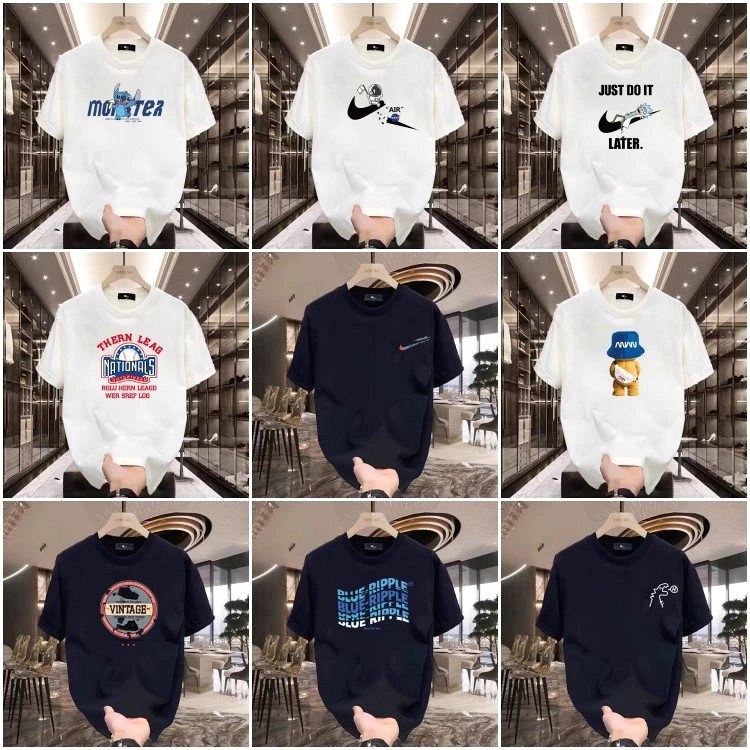
Our assigned test for this shirt was narrow and slightly pedantic. The listing describes the fabric as pure cotton in a 180–250 gsm band. Eight years of measuring garments teaches you that a 70-gram spread is not a specification; it is a range wide enough to hide two quite different shirts. So we ordered two units from SKU 7715851691 — size L in black and size L in white — and tried to place this tee inside that band ourselves.
Both units are part of the 40-option picker: nineteen cartoon motifs repeated in white and black, plus a plain white and a plain black. Sizes run M, L, XL, XXL, XXXL, XXXXL and 5XL. The listing shows $3.88 against a $4.39 original, and everything we ordered was in stock.
The gsm arithmetic, done on the bench
We weighed each shirt flat on the scale, then taped out the front panel, back panel, both sleeves and the collar rib to estimate total fabric area. The black unit came in at 197 g, the white at 194 g. Fabric area worked out at roughly 1.01 m² once seam allowances were counted, which puts the jersey at about 193–197 gsm — inside the claim, but in its bottom third.
| Bench check | Listing states | Our size-L measurement |
|---|---|---|
| Garment weight, black unit | not stated | 197 g |
| Garment weight, white unit | not stated | 194 g |
| Estimated fabric area | not stated | ~1.01 m² |
| Calculated fabric weight | 180–250 gsm | ~193–197 gsm |
| Flat chest, pit to pit | letters only, 1–3 cm tolerance | 52.5 cm |
| Body length, high point shoulder | not stated | 71 cm |
| Sleeve, shoulder seam to hem | short sleeve | 21.5 cm |
| Collar rib depth | round neck | 2.0 cm |
| Price paid per unit | $3.88 (from $4.39) | $3.88 |
What roughly 195 gsm feels like when worn
At this weight the jersey has a soft, slightly fluid hand rather than the dry body of a heavyweight tee. The relaxed cut has room through the chest and drops cleanly from the shoulder, and the short sleeve ends mid-bicep without flaring. On the black unit there is no show-through at all. Against the light box, the white unit stays opaque over the body and only reads faintly at the shoulder seam when we stretched the panel, which is what you would expect from cotton near the bottom of a 180–250 band — and a reason to think twice before ordering the white if you plan to wear it uncovered in bright sun.
Neither unit had a chemical smell out of the bag, and both hung out of their creases within a few hours. The listing's fabric-function lines claim breathability, moisture wicking, crease resistance, stretch and colourfastness; we can speak to the first and, loosely, the third. The "high stretch" descriptor sits oddly on a pure cotton jersey, and we would treat it as marketing language rather than an elastic property.
Nineteen motifs, two grounds, forty options
Our two shirts carry different graphics, so we can only report on what we held. Print registration on both was sharp, with no halo or drift at the edges, and the ink sits on the surface of the cotton rather than sinking into it — the chest box feels marginally stiffer than the surrounding jersey when you pinch it. We could not inspect the other seventeen motifs, so any claim about consistency across the full picker is unverified. The listing gives a single fabric specification for the whole range, which suggests one base shirt across all options, but that is inference, not measurement.
Sizing when the picker gives letters and a tolerance
There is no numeric chart in front of us, only the size letters and a stated 1–3 cm deviation. That makes your own tape measure the only reliable input. The sourced guidance points the same way, and warns against solving uncertainty by sizing up or down:
"When choosing a size, decide from your own measured numbers — too large looks sloppy and shapeless, too small loses the looseness it is meant to have."
We would add one practical adjustment. Cotton at this weight is a shrinkage risk after a warm wash or a tumble dry, and the sources we found flag it without quantifying it:
"Cotton T-shirts can shrink after washing or drying, but I'm not sure by how much."
What we could not settle
Print longevity is the open question. The only independent durability signal we found concerns Nike tops in general rather than this listing, and it is a single buyer's report:
"My lightly worn black Nike polo shirt is losing its Nike emblem after six months of ownership."
That is a caution about surface decoration on Nike apparel, not a finding about this tee, and we did not reproduce it on either unit in our short test window. Treat the print as a cheap-shirt risk, wash cold and inside out, and skip the tumble dryer. Those two habits answer both the shrinkage gap and most of the print-durability gap in one go.