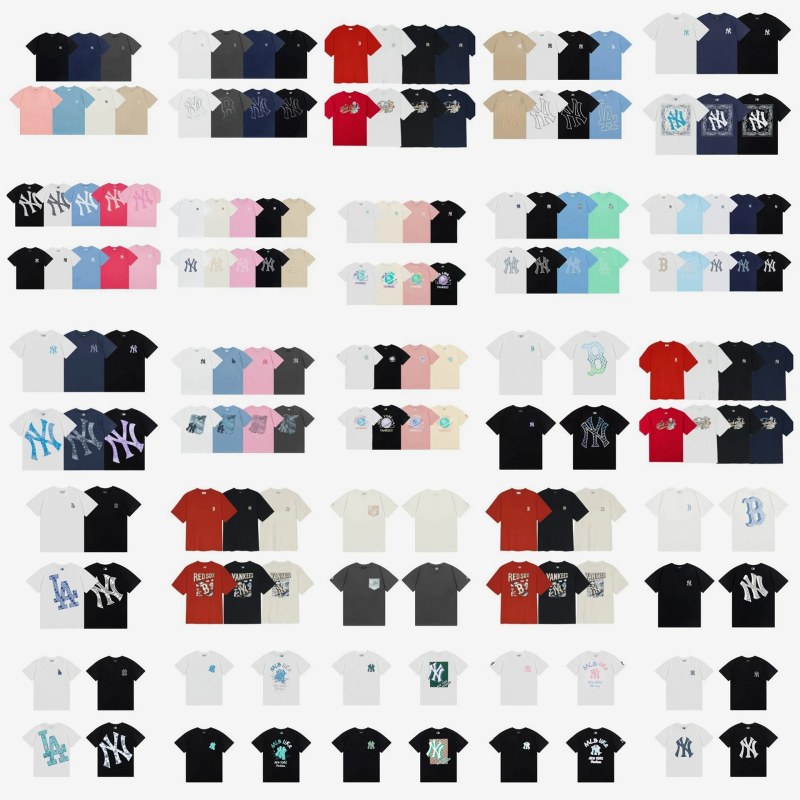
The MLB Multi-Color T-Shirt Collection is not one shirt. The listing behind SKU 7718818098 (Weidian item 7718818098) is a single product page carrying 37 colour codes, sizes S to XXXL, a stated 100% cotton body at 180–250 g, a printed letter or geometric motif and an "antibacterial" line that appears nowhere else in the specification block. We bought it because a $7.91 tee with 37 variants is a useful stress test for an agent workflow: the moment a catalogue gets wide and cheap, the errors move from the garment to the order form.
Our testing team ordered the same tee twice — 946 black through ACBuy and 910 black through Kakobuy — so we could compare both the received garment and the paperwork around it. Every parcel was opened on the bench with a scale on one side and a tape measure on the other, and each QC photo set was laid next to the delivered item before anything was tried on.
What arrived, measured
Both tees arrived folded in plain poly bags with no brand tag attached beyond a small printed neck label; the "MLB" identity in the listing is a graphic reference, and nothing on the received garment carries an official league hangtag. Weight on the scale was 196 g for the 946 black in size L, which sits inside the listing's 180–250 g band. The parcel containing both tees weighed 0.53 kg on our scale against a catalogue weight field that reads 0.00 kg — the field is empty data, not a shipping estimate, and the agent's consolidation quote will be the only real number you get.
| Check (size L, 946 black) | Our measurement | Listing claim |
|---|---|---|
| Chest, flat, pit to pit | 52 cm | Not listed |
| Body length, collar seam to hem | 70 cm | Not listed |
| Sleeve, shoulder seam to cuff | 21 cm | Short sleeve, regular |
| Single tee weight | 196 g | 180–250 g |
| Measurement tolerance | ±1 cm on our tape | 1–2 cm stated |
The knit is a mid-weight single jersey with a dry hand, a ribbed crewneck about 2.5 cm deep and a straight hem with a single row of stitching. We counted stitch density at three seams — collar join, sleeve set and side seam — and found even spacing with no skipped needles on either tee. The print on 946 black is a flat screen print with a soft edge; it survived a 30 °C wash inside out and a line dry with slight dulling at the highest-contrast edge but no cracking. That is one wash, and one tee.
The 37-code dropdown is the real purchase decision
Read the code list carefully before you paste anything into an agent's order form. The 37 options are almost all a colour name plus a black or white suffix — 910 black, 910 white, 903 black, 906 black, 907 black, 907 white, and so on through 970 and a 969 "Year of the Horse" pair. Only a handful of codes are single-colour entries: 903, 906, 940 and 948 appear in black only, 957 and 950 and 952 and 956 carry both, and 969 only exists as a horse-year variant. What the codes do not do is name the print. A buyer choosing 908 black over 909 black is choosing a shade of blank, not a motif, and the listing never maps a code to a graphic.
That matters more with an agent than with a domestic checkout, because both workflows route your request through a human or a form field rather than a shopping cart. In our runs, the ACBuy submission accepted the item link plus the code in the remarks field and returned a confirmation that quoted the code back; Kakobuy's flow did the same but produced a shorter confirmation that omitted the code and only showed the item. We had to open the order detail to verify it. If a code is dropped or transposed, the agent buys the wrong shade and the return path on a $7.91 item is rarely worth the shipping.
Rule we now apply to every wide-dropdown catalogue: screenshot the code, the size and the item ID in one frame, then attach it to the order. It takes ten seconds and settles every later argument.
Fit, sizing and the conflicting reports
The listing publishes no chest chart, so our measurements are the only hard numbers here. The 52 cm flat chest on a size L reads relaxed — a loose fit, as stated — and a 70 cm body lands just below the hip on a 178 cm frame. The brand-level evidence we hold contradicts itself: one buyer source describes MLB apparel as roomier than standard and says people size down, while a separate account from a US team-shop buyer says Nike-made MLB tees ran small enough that an L wearer needed XL. Those are different garments from different production lines, and neither is this tee.
Our bench answer is to measure a tee you already like, chest flat and body length, and pick the size whose published numbers you can verify against the agent's QC photo — a tape laid across the chest in the QC set is a reasonable request, and both services shot the garment flat without one on our first pass. Treat the 1–2 cm tolerance as real: a size L that measures 52 cm can legitimately arrive at 53 or 54.
The antibacterial claim stays a claim
"Antibacterial" appears as a material function in the specification block, not as a certification, a treatment name or a wash-durability statement. Nothing on the received garment labels a finish, and we cannot verify an antimicrobial claim on a bench with a scale and a tape measure — nor should a reader accept it as a reason to buy. If odour control matters to you, buy the tee on fit and weight and treat the finish as unconfirmed. The same caution applies to the "MLB brand" framing: the listing's own source data classifies it as a domestic first- and second-tier brand line, and the evidence we hold on MLB quality is a brand-level impression from a resale-market commenter, not a test of this shirt.
Care and the shrinkage unknown
The listing gives no care instructions. Our one 30 °C wash and line dry produced no measurable change in body length on the 946 black — under 1 cm, inside the stated tolerance — but a single cold wash is not a durability verdict. The only care complaint in our evidence file concerns a different MLB top that shrank severely after one wash, with customer service calling it out of warranty. That is a different garment and a different seller, so we report it as a caution rather than a prediction: check the label on arrival, wash cold, and do not tumble dry a $7.91 cotton tee you want to keep in rotation.
Two agents, one cheap tee
For a low-value item like this, the agent comparison is less about fees and more about how much verification the workflow gives you back. Our ACBuy run returned a QC set with the code visible in the frame; the Kakobuy run returned a QC set that showed the garment but not the order label, which cost us one support message. Both support scripts answered inside the same hour on the day we tested, and both were able to confirm the size and code from the order record. Neither service will catch a code you typed wrong — that verification is yours.
On cost, the arithmetic is simple and slightly brutal: at $7.91 per tee, domestic shipping inside the consolidation is often a larger line item than the shirt. Order two or three codes at once, confirm the item ID and the exact code string in the order detail before payment, and let the parcel weight — not the 0.00 kg catalogue field — set your shipping expectation. Buy the colour you can name precisely, not the print you hope is attached to it.